
From the ACM SIGGRAPH, Vol.32 No.2 May 1998: Game Graphics During the 8-bit Computer Era – a look at what was possible when all you had for graphics hardware was a large rock and a piece of chalk operating at 2MHz, some of the hacks that were used to squeeze the very last drop of functionality out of those systems and some of the more notable games insofar as their graphics.
Category Archives: Nostalgia
Commodore 64 turns 25
Old mags
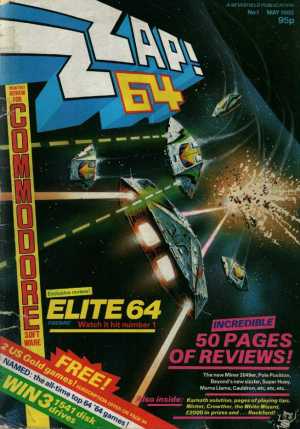 Back in the day, we couldn’t just jump online to find out what was happening in the geek world. No, we had to go down to the newsagent and buy a magazine.
Along with emulators for many old platforms, increasing numbers of old mags from the 80s and 90s are now available online.
Commodore: Australian Commodore and Amiga Review (via Dan). ZZap! 64. Lots more at the Amiga Magazine Rack
But the ultimate in technical mags for Commodore machines would have to have been The Transactor.
Acorn: The Micro User, Acorn User
Sinclair: Crash
There’s plenty more out there (including some sites that just index the old magazines, rather than provide actual scans). Well worth an explore to nostalgically relive your favourite computer platform.
Play Commodore 64 games online
Why did nobody tell me about this before?
Play Commodore 64 games online, using Java
One issue though: I haven’t figured out yet what simulates the Run/Stop key, which some games use to start.
(via Pete)
Influential games
Henry Lowood curator at the Stanford University History of Science and Technology collections has named the 10 most important video games of all time: Spacewar, Star Raiders, Zork, Tetris, Sim City, Super Mario Bros 3, Civilization, Doom, Warcraft and Sensible World Of Soccer. And I can understand why he’s gone for the most influential, rather than the most popular.
Pacman didn’t make the grade, but the new Pacman Championship edition for XBox 360 has just come out (available via XBox Live). And it appears to be a re-design (not just a graphical revamp) that attempts to bring new gameplay in, while not trying to break the fundamentals of the game (like the 80s and 90s Pacman sequel games did, trying to make the field 3D, or turning it into a platform game). Pictures. Review from Joystiq.
Orchestral video games
Video game themes arranged for orchestra
Interview with David Braben (Elite)
Video from the BBC’s “Click” interviewing co-author of legendary 80s game Elite, David Braben, offering his thoughts on the latest games development, and looking around the London Science Museum’s Game On exhibition. (via Tim)
Nostalgia++
Over on my personal blog I’ve posted about visiting the ACMI “Hits of the 80s” video game exhibit. Well worth a look for any nostalgic geeks in, or passing through, Melbourne.
It’s great to see ACMI’s Games Lab giving computer games some recognition for the important cultural impact they’ve had. While we may never again see something like Space Invaders causing a shortage of coins in Japan, or pop songs written about Pacman, games are a huge industry, and a big influence over popular culture.
Who invented microcomputing?
There seem to be a number of histories out there that try and paint Microsoft’s Bill Gates and Paul Allen or Apple’s Steves Jobs and Wozniak as the inventors of microcomputing.
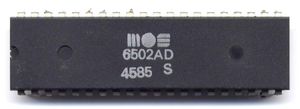 I reckon it couldn’t be farther from the truth. I reckon it was Chuck Peddle.
Chuck Peddle not only invented the 6502, which cut the cost of microprocessors markedly (making them affordable to people like the Steves to play around with them and put into the Apple) he was also behind the PET, from which the Vic-20 and Commodore 64 were descended.
These were the first computers to sell in their millions, introducing affordable microcomputing to the masses of the western world, and pathing the way for the PCs and Macs you see in homes today. (The Commodore 64 is still the biggest selling computer of all-time, though given the proliferation of PCs, I suppose the comparison is a little unfair.)
And the 6502 went not only into Commodore and Apple machines, but also into Ataris (including the VCS 2600), the BBC Micro, Nintendo NES and many others. It’s said it directly inspired today’s ARM processors (ARM came out of Acorn, the BBC Micro manufacturers) now found in so many consumer electronic devices. (So is the 6502, as it happens.)
Commodore BASIC was bought from Microsoft, making Commodore one of their earliest big customers (though it was a cut-throat deal). Microsoft’s BASIC went into a lot of other computers at the time, and lives-on in Visual Basic, now the most popular programming language on the planet.
As Peddle says in the book I’ve just finished reading (On The Edge — The Spectacular Rise and Fall of Commodore by Brian Bagnall), “We changed the world.” And he’s right.
Unfortunately Commodore’s role in all this tends to get overlooked in many histories, such as Triumph of the Nerds and the like.
Other things I learnt reading the book:
- Jack Tramiel was a ruthless businessman, but he did make this all happen, until he was ousted from Commodore by Irving Gould.
- Irving Gould couldn’t organise a piss-up in a brewery. He and many of his appointments were the epitome of bad management, and what directly drove Commodore to bankruptcy.
- The Commodore marketing department produced some real clangers of promotions, which didn’t properly advertise the great machines at all well.
- Some of the brilliant engineers involved should have been household names, but alas aren’t. That’s the way of the world I suppose.
- The PET had a metal case because Commodore had a file cabinet-making business.
- The C64 had the same case as the Vic-20 because they didn’t have time to build anything else.
- I must have been out of my mind when I bought that Commodore Plus 4 all those years ago. Obviously I couldn’t see it at the time, but it had lemon written all over it.
- The Amiga 1200 I bought in the early 90s was a much better buy. One day I hope I can play the Amiga AGA version of Aladdin again.
- People who are useless are known as human NOPs.
All in all, the book is a great read. Bagnall and his editors apparently don’t know how to use apostrophes, but that doesn’t detract from what is a compelling story. Recommended, especially for anybody who dabbled with computers in the late 70s or 80s.
Classic videogame ringtones
I’ve switched my ringtone. I wanted something distinctive but not crass and loud. I ended up deciding on the intro theme from Galaga. The text alert tone is the sound from Galaga when you put a coin in.
- galaga-ring.mp3 (117 Kb)
- galaga-sms.mp3 (12 Kb)
And it turns out it’s quite easy to do — provided your phone is newer than Josh’s and supports music files (eg MP3, WAV or AAC)… which most from the last couple of years do.
If you run Mame32, it’s got an option to record the sound as you play the game (on the File menu). This saves to a WAV file. Load it up into Sound Recorder and snip away (using Edit / Delete before or after current position). Some other MAME variants may have this feature too.
Some phones will support WAV, but if not (or you want to minimise the file size), convert to MP3 or your preferred format using Bladeenc or any other encoder. Transfer it onto the phone using a cable or IR link, then customise the ringtone and alert sound (on my Nokia it’s via Profile / General / Personalise). Easy!
If you know me in person, please find something else to use, so I know it’s mine going off when I hear it 🙂
Some other classic video game sounds that spring to mind as suitable are the Pacman theme (and dying sound for alerts) and Donkey Kong’s “How high can you jump?” theme (with the jumping barrel sound for the alert).
Nostalgia++
Could this prune iPod’s market share with the power of Nostalgia? Commodore (yes, that Commodore) announces a portable media player. Gawd knows why it’s called “Gravel In Pocket” though. They’re also readying a home media product.
Oh, there’s speculation new iPods aren’t far away.
Meanwhile this guy has built a USB keyboard out of an old Commodore 64.
This is a fun read: Halcyon Days: Interviews with classic games programmers.
Emulation saves the day
This is cool: Emulating a BBC Micro, Amstrad, Spectrum or Dick Smith VZ300 in a Java applet. Maybe I’ve been wrong in dissing Java.
Speaking of Beebs, apparently a version of cross-platform emulator BeebEm has been used to try to ressurect the 1980s BBC Domesday project. It makes interesting reading, particular with regards to the problems of digital preservation… not to mention the value of the resource in being a record of life in Britain from the time it was compiled.