Stop Ian Frazer turning your daughter into a Wanton Slut

Ian Frazer (born January 6th, 1953) is an Australian immunologist, best known for his work on the development of a cervical cancer vaccine, which works by protecting women from Human papillomavirus (HPV). In January 2006 he was named Australian of the Year. — Source:Wikipedia

Now, this is a vacine, not a cure. It will only protect you if you get vacinated prior to exposure. HPV is a STD transferred regardless of condom use. It is also transferred mother-to-child in the birth canal.

In another example of misogynistic intervention, the Christian Right in the USA is opposing mandatory vaccination against the Human papillomavirus vaccine. I can imagine economists wanting to block it (at USD$300-$500 per patient), but they’d have no leg to stand on (USA: 4K deaths/pa @$1m each =$4b; that buys you 8m-12m vacinations per annum, which is more than the number of people you’d be looking to vacinate – figures go higher if you count number of non-fatal cancer cases, lower if you lower the value of the affected lives). The administration in the US is leaning towards the Christian Right’s views.

Katha Pollitt thinks that blocking this vaccine is the stupidist thing imaginable:

Raise your hand if you think that what is keeping girls virgins now is the threat of getting cervical cancer when they are 60 from a disease they’ve probably never heard of.

She rants like someone who cares. Cares a lot. Read her article.

“Sailorman” says that by not mandating this vaccine, the US government isn’t being rational:

I am a parent. And I confess that even though I KNOW the statistics, saying “sex” and relating it to “your 10 year old daughter” gives me the heebie-jeebies. But you bet your ass I’d have her in there for the shot.

He then goes on to give a detailed logical analysis that leads to the same conclusion as Katha Pollitt’s “Raise your hand” opinion.

CSL (an Aussie company) have been trying to make this vaccine fly:

CSL is working with Merck and Co. Inc (USA) to develop a vaccine to prevent cervical cancer and genital warts. The vaccine is based on proprietary virus-like particle (VLP) technology developed at the University of Queensland. This technology produces virus-shaped particles which mimic the real virus to produce a safe and effective immune response. The vaccine has four VLP components covering the HPV types 16, 18, 6 and 11. Following smaller scale clinical trials, the vaccine is now in advanced trials aimed at demonstrating its safety and effectiveness in tens of thousands of subjects.

I wonder what the Australian government’s position on this is? What would you guess? After all, Ian Frazer was named Australian of the Year.

Update: In 2007 the vaccine was listed in Australia for teenage females, and from February 2013 all 12 and 13 year olds are immunised.
Keeping your PC pure and fast with virtualisation

A couple of weeks ago Josh posted about virtualising your overloaded, slow, not-rebuilt-for-years PC, and keeping it on standby within a new build in case you need anything on it.

How about the idea of keeping that new build clean — putting on only your most frequently used, essential applications, with everything else going onto a virtual PC?

For me, that would mean Office, Firefox, my usual web-building stuff (Photopaint, UltraEdit, Filezilla), Nero, and one or two others, such as perhaps Trillian. I’d draw a line under them, and anything else not worthy of a permanent spot in my Windows setup would be virtualised, possibly in various separate virtual PCs, setup for different roles: one for Visual Studio, one for trying out freebie apps from mags, a Linux setup for LAMP development, one for stupid software that insists on running as Administrator, etc, etc.

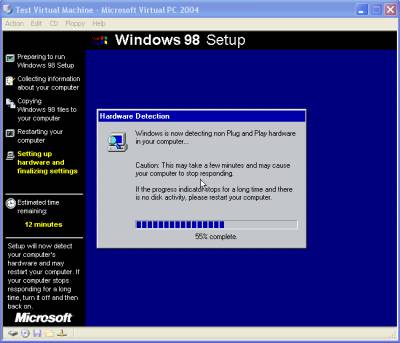
Windows 98 under Virtual PCWhat to use for the virtual machines? There’s a few different options.

The freebie Virtual Server will only support Windows NT 4 and above, and only server OS’s, which to my mind would unnecessarily weigh down your virtual machines with more than they need. (Linux as a guest OS seems to be coming.)

Another option is the free VMWare Server, which will host a wider range of guest OSs.

The non-free Virtual PC will host just about any x86 operating system. If you don’t want to try the 45 day free trial, it’ll set you back A$215 or so, or it’s available via MSDN Universal.

A problem would be performance, of course. It’s not like emulating a 2Mhz 6502 under BeebEm. But then, hopefully it’s not as bad as what I’ve seen on my brother-in-law’s PowerPC Mac trying to run x86 AutoCad in Windows 2000.

Nonetheless games and other performance-intensive apps may not perform well under virtualisation, especially if they require particular hardware. And yet they would benefit the most, as they often have installers that wreak havoc on Windows setups, chucking weird-arse DLLs everywhere. As the “Virtual PC Guy” is fond of telling us, a lot of the older games run okay, but newer ones might be a problem.

Maybe the only solution there is to put them on a completely separate computer, or move up to Intel’s latest chips which have better support for virtualisation.

Or give the whole thing up and resign yourself to a slow computer with rebuilds every year or two.

I think I’ll try Win98 with a couple of recent-ish games (say, Midtown Madness 1 and 2) and see how it goes.

Nifty: Force Directed Graphs in Javascript

Starts off as a mess, then...
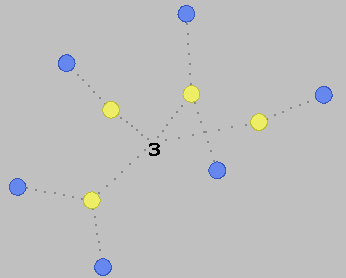
Kyle Scholz has developed code to represent Force Directed Graphs in Javascript, and you can interact with the nodes. We’re talking mathematical directed graphs here – you might know them as networks.

Basically, there’s a bunch of nodes and they settle themselves into a stable state minimizing tension between them – the graphs balance themselves out, and you can see it happening – it’s animated. And interactive – you can grab a node and move it around. It is ubercool.

Downside is that it sucks huge CPU.
... eventually becomes balanced

Where’s it made, and for how much?

Them iPods are funky devices, “designed in California”, so the box says. And, as revealed by the UK’s Mail On Sunday, built in factories in China in somewhat squalid conditions. One factory has 15-hour workdays for US$50 per month. Another is slightly better: 12-hour days for US$100 per month (but about half of that is paid back for housing and food).

Mind you, I suspect this isn’t unusual in the consumer electronics business. Just about nothing’s made in Japan or the USA or other high-cost (read: decent wage) countries.

The only thing I can think of that I’ve got is a Loewe TV, made in Germany.

Update Monday: Apple says: “”Apple is committed to ensuring that working conditions in our supply chain are safe, workers are treated with respect and dignity, and manufacturing processes are environmentally responsible” and is investigating the claims.